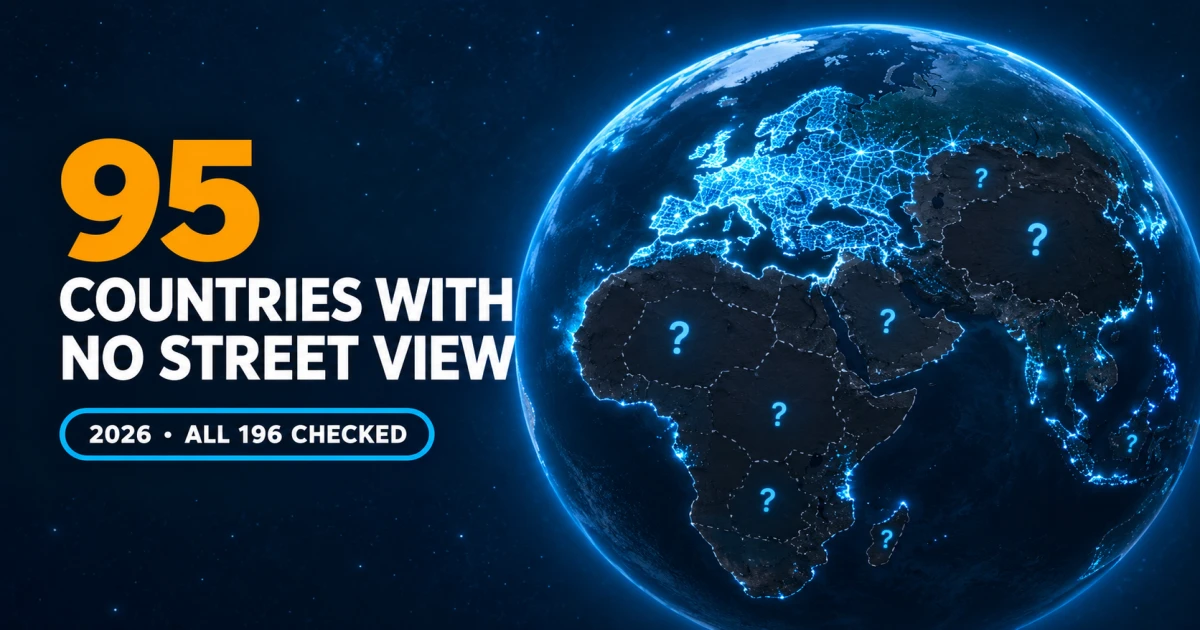
95 of the world’s 196 countries have no Google Street View on their roads in September 2026. In 85 of them, Google has published no imagery of its own, apart from a few metres at some border crossings. The other 10, including China, Egypt and Pakistan, have only a handful of landmarks, museums or walking trails.
Those 95 countries are home to about 3.2 billion people, or 40% of the world’s population, according to World Bank estimates for 2024. China alone accounts for 1.4 billion of them. The gaps are shrinking, though: 14 countries got or regained Street View on their roads between March 2024 and July 2026, most recently Georgia and Kosovo.
We checked all 196 countries (the 193 UN member states plus Kosovo, Palestine and Vatican City) on 16 September 2026. We used Google’s own announcements, Wikipedia’s coverage pages, the Plonk It country guides written for GeoGuessr players, and Google Maps itself. Below you’ll find the full list, what’s on the record about the biggest gaps, and where you can still explore the streets.
Key Takeaways
- 95 of 196 countries have no Street View on their roads, and about 40% of the world’s people live in them. 85 have no Google imagery at all; 10, including China, Egypt, Pakistan and Belarus, have landmarks only.
- Africa and the small island states are the biggest gaps. Only 13 of Africa’s 54 countries have road coverage, and 33 of the 37 small island developing states in our count have no Google imagery.
- Google hasn’t published a reason for any of the gaps. Five of the 95 (China, Cuba, Iran, North Korea and Syria) are on Google’s Maps Platform prohibited list, which covers its developer products and doesn’t mention Street View. For the other 90, we found no published ban or official explanation.
- The map keeps filling in. Kazakhstan, Oman, Nepal, Paraguay, Georgia and Kosovo are among 14 countries that gained Street View on their roads since 2024, and Google cars have already been spotted in Kuwait.
- Want to explore places Street View doesn’t cover? Where Am I? uses street walk videos, including a China campaign, and it’s free on iOS, Android and the web.
Which countries don’t have Google Street View?
These 85 countries have no Google Street View imagery as of 16 September 2026. Some have 360° photos uploaded by users, and a few have a short stretch where a Google car crossed the border, but Google has not published its own imagery of their streets.
Africa (37): Algeria, Angola, Benin, Burkina Faso, Burundi, Cabo Verde, Cameroon, Central African Republic, Chad, Comoros, Democratic Republic of the Congo, Djibouti, Equatorial Guinea, Eritrea, Ethiopia, Gabon, Gambia, Guinea, Guinea-Bissau, Ivory Coast, Liberia, Libya, Malawi, Mauritania, Mauritius, Morocco, Mozambique, Niger, Republic of the Congo, Seychelles, Sierra Leone, Somalia, South Sudan, Sudan, Togo, Zambia, Zimbabwe.
Asia (16): Armenia, Azerbaijan, Bahrain, Brunei, Iran, Kuwait, Maldives, Myanmar, North Korea, Saudi Arabia, Syria, Tajikistan, Timor-Leste, Turkmenistan, Uzbekistan, Yemen.
North and Central America and the Caribbean (16): Antigua and Barbuda, Bahamas, Barbados, Belize, Cuba, Dominica, El Salvador, Grenada, Haiti, Honduras, Jamaica, Nicaragua, Saint Kitts and Nevis, Saint Lucia, Saint Vincent and the Grenadines, Trinidad and Tobago.
Oceania (11): Fiji, Kiribati, Marshall Islands, Micronesia, Nauru, Palau, Papua New Guinea, Samoa, Solomon Islands, Tonga, Tuvalu.
South America (3): Guyana, Suriname, Venezuela.
Europe (2): Moldova, Vatican City.
Ten more countries have Google imagery of a few landmarks but none of their roads: Afghanistan, Belarus, China, Egypt, Iraq, Madagascar, Mali, Pakistan, Tanzania and Vanuatu. They’re covered in the next section.
How we count: a country has Street View “on its roads” when Google has published its own imagery of public roads, even if only in some cities. “Landmarks only” means Google imagery of specific sites but not the road network. Photos uploaded by users or organisations don’t count, because they aren’t Google’s coverage.
Europe is almost complete. Only Moldova and Vatican City have no Google imagery, and Belarus has a single walking route in Minsk. Oceania is the emptiest region, with road coverage only in Australia and New Zealand. In Africa, 41 of 54 countries have no Street View on their roads.
The small island nations stand out most. The UN lists 39 small island developing states, and 37 of them are among our 196 countries. 33 of those 37 have no Google imagery at all. Only Singapore, the Dominican Republic and São Tomé and Príncipe have Street View on their roads, and Vanuatu has imagery of a single island.
Which countries only have landmarks on Street View?
Ten countries have Google imagery of a few places but not of their road network. You can walk around a museum or a heritage site, but you can’t follow a street from one town to the next.
| Country | What Google has published |
|---|---|
| Afghanistan | A few buildings in Kabul |
| Belarus | One walking route through the historic centre of Minsk, plus short spills from Russia |
| China | Tripod shots of a few museums and sites, mainly near the east coast |
| Egypt | The Giza pyramids and other historic sites, first added in 2014 |
| Iraq | The inside of the National Museum of Iraq in Baghdad |
| Madagascar | Trekker and boat imagery, with no car coverage |
| Mali | Ten small trekker spots at seven locations |
| Pakistan | Heritage sites in Punjab, such as Lahore Fort |
| Tanzania | Gombe National Park, Mount Kilimanjaro and short spills from Kenya |
| Vanuatu | Ambrym island only |
Sources: Plonk It country guides and Wikipedia’s Street View coverage pages, checked 16 September 2026; Daily News Egypt (2014) for Egypt.
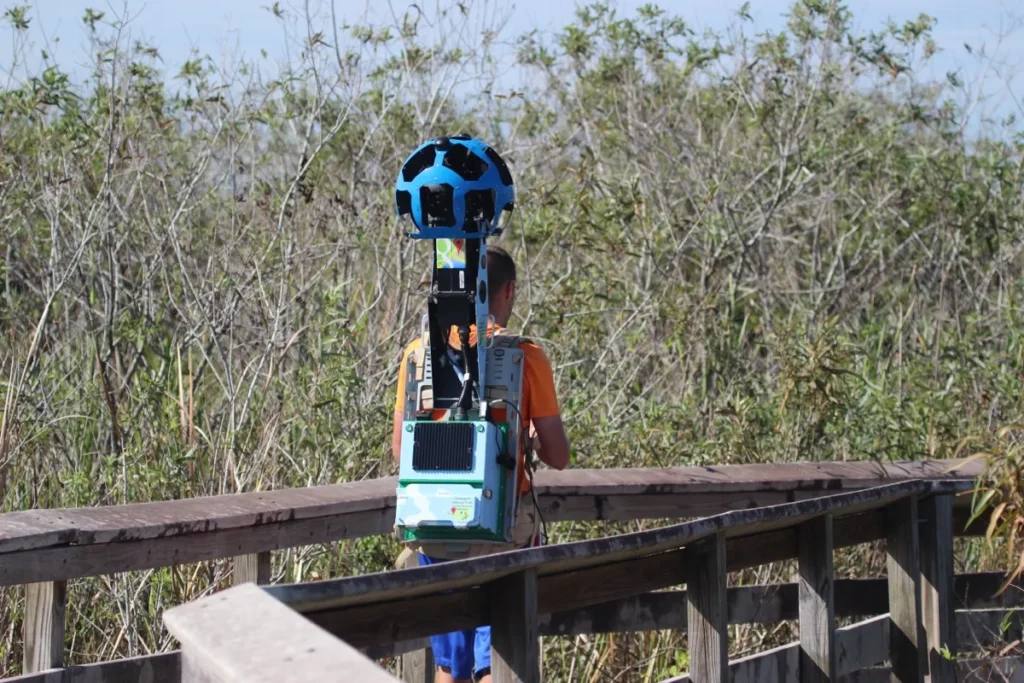
Most of this imagery was shot on foot. For eight of the ten countries, the Plonk It guides describe the coverage as trekker imagery, at least in part. Google describes the Trekker as a portable camera that can be worn as a backpack to reach places “we can only reach on foot”.
Why do some countries have no Street View?
Google hasn’t published a reason for any of the 95 countries. Five are on its Maps Platform prohibited list. For the other 90, including Egypt, Morocco, Pakistan and Saudi Arabia, we found no published ban, law or statement explaining the gap. What we can show is what they have in common.
For scale, Google says Street View is “available in over 110 countries”. That is close to our own count: 101 countries with roads plus 10 with landmarks only makes 111.
Five are on Google’s prohibited list. China, Cuba, Iran, North Korea and Syria appear on the list of territories where Google prohibits the use of its Maps Platform services. That list covers Google’s developer products, not Street View, and it can’t explain everything: Vietnam is on it too, and Vietnam has had Street View again since 2025.
33 are small island developing states. They run from Barbados to Tuvalu. That’s a pattern we noticed, not a reason anyone has published. We found no ban in any of them, and none appears on the driving schedule behind Google’s “where we are mapping” page. (Cuba, also a small island state, is counted in the prohibited group, and Vanuatu, which has landmarks only, is counted here.)
The other 57 have no explanation we could find. They range from Ethiopia and Morocco to Uzbekistan and Honduras.
Why is there no Street View in China?
China has no Street View on its roads, only tripod shots of a few museums and sites, mostly near the east coast, according to Plonk It. Google hasn’t said why, but two factors are on the record. First, online mapping there is tightly regulated. In 2010, China began requiring every company offering online maps in the country to apply for government approval. Foreign firms had to set up joint ventures or partnerships with local companies, AFP reported in 2011. Second, China is one of the five countries on Google’s prohibited list.
Baidu Maps has its own street panoramas of Chinese cities, which launched in 2013 under the name Total View (The Next Web). Hong Kong and Macau, which aren’t among our 196 countries, do have Google car coverage.
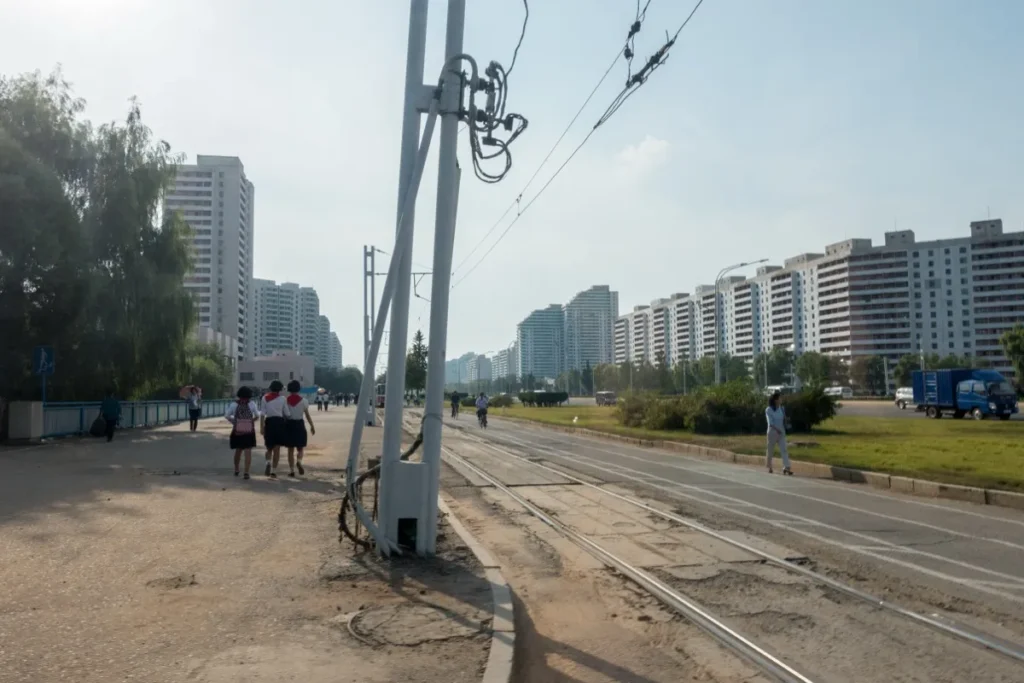
Why is there no Street View in North Korea?
North Korea has no Google imagery at all, and we found no statement from Google on why. Two facts frame the gap. The country is on Google’s prohibited list. And US passports have been invalid for travel to North Korea since 1 September 2017 unless specially validated. In July 2026 the US State Department extended that restriction until 31 August 2027 (Federal Register).
Why is there no Street View in Cuba?
Cuba has no Google imagery either. It is also on Google’s prohibited list, and we found no statement from Google on whether that is the reason. Just across the Florida Straits, the Street View layer covers Florida almost road by road.
Why don’t Egypt, Morocco and Saudi Arabia have Street View?
Egypt got Street View of the Giza pyramids, the Saqqara necropolis and four other historic sites in September 2014 (Daily News Egypt), but its roads have never followed. Morocco and Saudi Arabia have no Google imagery at all. We found no published ban or official explanation for any of the three.
Saudi Arabia shows how misleading the map can look. Turn on the Street View layer over Riyadh and the city is criss-crossed with blue lines. The imagery we opened, though, had been uploaded by an individual contributor in October 2024, not by Google. Google’s own imagery credits “Street View” or “Google Maps”, while uploads from other people show the contributor’s account name (Google).
Why is Belarus almost blank?
Belarus has a single walking route through the historic centre of Minsk, plus short spills where Google cars crossed the border from Russia, according to Plonk It. On the Street View layer, the contrast with Lithuania, Latvia and Poland, which are covered almost road by road, is stark (our check, 16 September 2026). We found no published explanation.
What about Afghanistan and Iran?
Afghanistan has Google imagery of only a few buildings in Kabul, first published in 2018, according to Wikipedia. Iran has none, and it is on Google’s prohibited list.
Countries that used to be blank
A missing country doesn’t always stay missing. Germany, India, Austria and Vietnam were once among the best-known gaps, and all four now have Street View on their roads.
Does Germany have Street View?
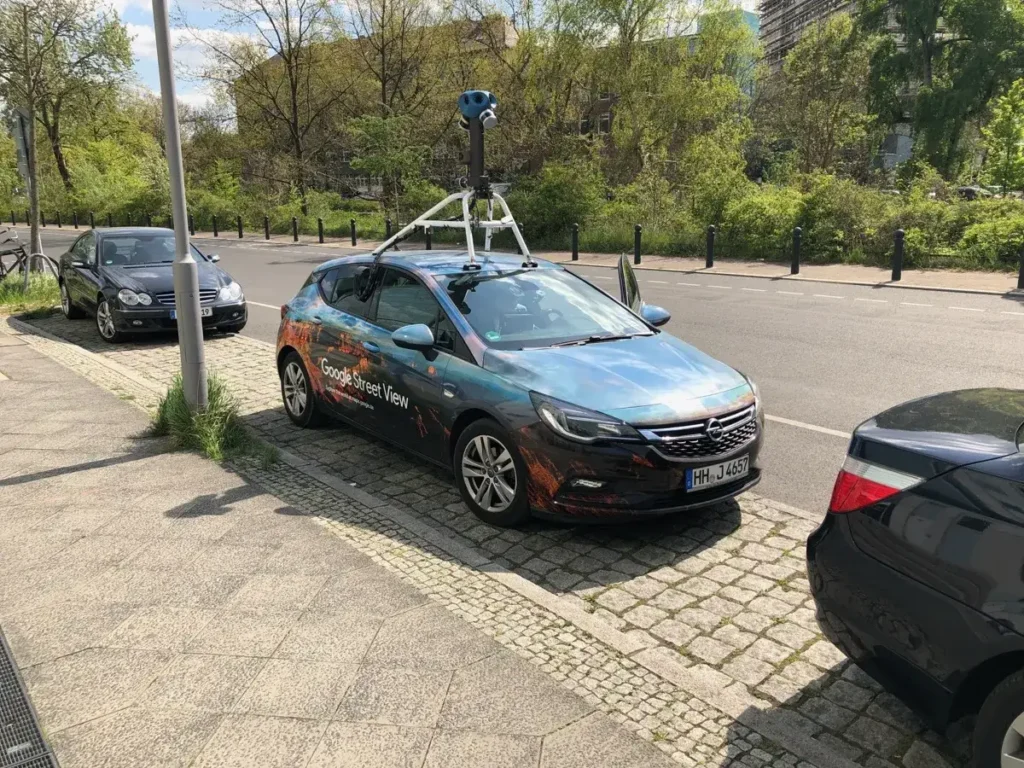
Yes. Before it launched in Germany’s 20 largest cities in 2010, Google let households ask for their homes to be blurred. Out of 8,458,084 households, 244,237 did, or 2.89% (Google Europe Blog). German imagery then went without an update for more than a decade. Google announced that its cars would return to German roads on 22 June 2023, for the first new captures since 2010 (9to5Google).
India: blocked in 2016, launched in 2022
India blocked Street View in 2016, amid fears that the imagery could expose sensitive defence installations. It launched in July 2022 after a new geospatial policy let local firms collect the data and license it to Google. Local partners Genesys and Tech Mahindra photographed 150,000 km of roads in 10 cities (TechCrunch). With 1.45 billion people in 2024 (World Bank), India is now the most populous country with Street View on its roads.
Austria: halted in 2010, live since 2018
Austria’s data protection authority halted Street View photography in 2010, during the row over Wi-Fi data collected by Street View cars. Austrian streets only went live in July 2018 (futurezone).
Vietnam: removed, then back in 2025
Vietnam’s earlier imagery was removed around 2021. Google published full coverage again in June 2025 (VirtualStreets), which puts Vietnam on our list of 2024 to 2026 additions.
The newest Street View countries (2024 to 2026)
14 countries got or regained Google Street View on their roads between March 2024 and July 2026.
The launch announcements show the scale. Namibia arrived in June 2025 with more than 21,000 km of imagery, and Bosnia and Herzegovina followed in November 2025, after Street View cars drove more than 30,000 km there. Georgia’s launch in June 2026 covered about 13,000 km of roads and tourist sites. It came through cooperation between Georgia’s Ministry of Economy and Sustainable Development and its innovation agency, GITA (Georgia Today). Google announced Kosovo on 31 July 2026.
Next in line: Kuwait. Google added it to its driving list in July 2025, and a Street View truck was spotted near Kuwait City that August (VirtualStreets), but no Google road imagery of Kuwait was live when we checked on 16 September 2026.
Which countries are missing from GeoGuessr?
GeoGuessr’s rounds come from Google Street View imagery, so the 85 countries with no Google imagery have nothing for its official maps to draw on. The 10 landmark-only countries offer just a few spots each.
New countries also take time to show up. GeoGuessr’s patch notes of 21 August 2026 added Georgia as a country in its Analytics, two months after Google published Georgia’s roads. When we checked on 16 September 2026, Plonk It, the community guide to GeoGuessr countries, still had no guide for Georgia, Kosovo, Bosnia and Herzegovina or Paraguay.
If you play GeoGuessr, our list of the 10 hardest countries to guess in GeoGuessr covers the countries that trip players up most, and Is GeoGuessr Free in 2026? explains what you can still play without paying.
Where Am I? works differently. It uses street walk videos rather than Street View, so its campaigns can take you to China, as well as Japan and India. Where Am I? is free on iOS, Android and the web.
How to see streets where Google Street View doesn’t go
Look for uploads on Google Maps. With the Street View layer switched on, Google marks its own coverage, photo paths and single photo spheres differently, and anything uploaded by a person or organisation shows their account name. In Benin, for example, the road imagery we opened had been uploaded in 2026 by an account called Benin Tourisme.
Use a local service. In China, that means Baidu Maps (see above).
Try Mapillary. Mapillary, owned by Meta, hosts street-level photos contributed by its users.
For more ways to wander the world from your sofa, see our virtual vacation guide.
All 196 countries, checked
Here is every country’s status on 16 September 2026. “Yes” means Google imagery on public roads, even if only in some cities. “Landmarks only” means Google imagery at specific sites but not on the road network. “No” means no Google imagery apart from border spills of a few metres.
Africa: 13 of 54 countries have Street View on their roads
| Country | Street View on roads? | Notes |
|---|---|---|
| Algeria | No | |
| Angola | No | |
| Benin | No | Road imagery we opened was uploaded by Benin Tourisme in 2026, not Google |
| Botswana | Yes | |
| Burkina Faso | No | |
| Burundi | No | |
| Cabo Verde | No | |
| Cameroon | No | |
| Central African Republic | No | |
| Chad | No | |
| Comoros | No | |
| Democratic Republic of the Congo | No | |
| Djibouti | No | |
| Egypt | Landmarks only | Giza pyramids and other historic sites, first added in 2014 |
| Equatorial Guinea | No | |
| Eritrea | No | |
| Eswatini | Yes | |
| Ethiopia | No | |
| Gabon | No | |
| Gambia | No | Only short spills over the Senegal border |
| Ghana | Yes | |
| Guinea | No | |
| Guinea-Bissau | No | |
| Ivory Coast | No | |
| Kenya | Yes | |
| Lesotho | Yes | |
| Liberia | No | |
| Libya | No | |
| Madagascar | Landmarks only | Trekker and boat imagery only |
| Malawi | No | |
| Mali | Landmarks only | Ten small trekker spots at seven locations |
| Mauritania | No | |
| Mauritius | No | |
| Morocco | No | |
| Mozambique | No | |
| Namibia | Yes | Added June 2025 |
| Niger | No | |
| Nigeria | Yes | |
| Republic of the Congo | No | |
| Rwanda | Yes | |
| São Tomé and Príncipe | Yes | First road coverage March 2024 |
| Senegal | Yes | |
| Seychelles | No | |
| Sierra Leone | No | |
| Somalia | No | |
| South Africa | Yes | Africa’s first Street View country, in 2010 |
| South Sudan | No | |
| Sudan | No | |
| Tanzania | Landmarks only | Gombe National Park, Mount Kilimanjaro and short spills from Kenya |
| Togo | No | |
| Tunisia | Yes | |
| Uganda | Yes | |
| Zambia | No | |
| Zimbabwe | No |
Asia: 28 of 48 countries have Street View on their roads
| Country | Street View on roads? | Notes |
|---|---|---|
| Afghanistan | Landmarks only | A few buildings in Kabul |
| Armenia | No | Yerevan imagery we opened was user-uploaded |
| Azerbaijan | No | |
| Bahrain | No | |
| Bangladesh | Yes | |
| Bhutan | Yes | |
| Brunei | No | |
| Cambodia | Yes | |
| China | Landmarks only | Tripod shots of a few museums and sites. Baidu Maps has its own street panoramas, and Where Am I? has a China campaign |
| Cyprus | Yes | Added November 2025; northern Cyprus not covered |
| Georgia | Yes | Added June 2026 |
| India | Yes | Blocked in 2016, launched in 2022 |
| Indonesia | Yes | |
| Iran | No | On Google’s Maps Platform prohibited list |
| Iraq | Landmarks only | Inside the National Museum of Iraq only |
| Israel | Yes | |
| Japan | Yes | |
| Jordan | Yes | Western Jordan only |
| Kazakhstan | Yes | First coverage March 2024 |
| Kuwait | No | Google cars spotted in 2025; nothing published yet |
| Kyrgyzstan | Yes | |
| Laos | Yes | |
| Lebanon | Yes | First road coverage April 2024 |
| Malaysia | Yes | |
| Maldives | No | |
| Mongolia | Yes | |
| Myanmar | No | |
| Nepal | Yes | Added August 2025 |
| North Korea | No | On Google’s Maps Platform prohibited list |
| Oman | Yes | First coverage October 2024 |
| Pakistan | Landmarks only | Heritage sites in Punjab, such as Lahore Fort |
| Palestine | Yes | West Bank only |
| Philippines | Yes | |
| Qatar | Yes | |
| Saudi Arabia | No | Riyadh road imagery we opened was user-uploaded |
| Singapore | Yes | |
| South Korea | Yes | |
| Sri Lanka | Yes | |
| Syria | No | On Google’s Maps Platform prohibited list |
| Tajikistan | No | |
| Thailand | Yes | |
| Timor-Leste | No | |
| Turkey | Yes | |
| Turkmenistan | No | |
| United Arab Emirates | Yes | |
| Uzbekistan | No | |
| Vietnam | Yes | Removed around 2021, back since June 2025 |
| Yemen | No |
Europe: 42 of 45 countries have Street View on their roads
| Country | Street View on roads? | Notes |
|---|---|---|
| Albania | Yes | |
| Andorra | Yes | |
| Austria | Yes | Streets published from 2018 after a long privacy dispute |
| Belarus | Landmarks only | One walking route in Minsk’s historic centre, plus short spills from Russia |
| Belgium | Yes | |
| Bosnia and Herzegovina | Yes | Added November 2025 |
| Bulgaria | Yes | |
| Croatia | Yes | |
| Czech Republic | Yes | |
| Denmark | Yes | |
| Estonia | Yes | |
| Finland | Yes | |
| France | Yes | |
| Germany | Yes | Fresh imagery since 2023, after the 2010 privacy row |
| Greece | Yes | |
| Hungary | Yes | |
| Iceland | Yes | |
| Ireland | Yes | |
| Italy | Yes | |
| Kosovo | Yes | Added July 2026 |
| Latvia | Yes | |
| Liechtenstein | Yes | First coverage October 2024 |
| Lithuania | Yes | |
| Luxembourg | Yes | |
| Malta | Yes | |
| Moldova | No | |
| Monaco | Yes | |
| Montenegro | Yes | |
| Netherlands | Yes | |
| North Macedonia | Yes | |
| Norway | Yes | |
| Poland | Yes | |
| Portugal | Yes | |
| Romania | Yes | |
| Russia | Yes | |
| San Marino | Yes | |
| Serbia | Yes | |
| Slovakia | Yes | |
| Slovenia | Yes | |
| Spain | Yes | |
| Sweden | Yes | |
| Switzerland | Yes | |
| Ukraine | Yes | |
| United Kingdom | Yes | |
| Vatican City | No | St. Peter’s Square imagery we opened was user-uploaded |
North and Central America and the Caribbean: 7 of 23 countries have Street View on their roads
| Country | Street View on roads? | Notes |
|---|---|---|
| Antigua and Barbuda | No | |
| Bahamas | No | |
| Barbados | No | |
| Belize | No | |
| Canada | Yes | |
| Costa Rica | Yes | Road coverage since August 2025 |
| Cuba | No | On Google’s Maps Platform prohibited list |
| Dominica | No | |
| Dominican Republic | Yes | Mainly Santo Domingo and Santiago |
| El Salvador | No | |
| Grenada | No | |
| Guatemala | Yes | |
| Haiti | No | |
| Honduras | No | |
| Jamaica | No | |
| Mexico | Yes | |
| Nicaragua | No | |
| Panama | Yes | |
| Saint Kitts and Nevis | No | |
| Saint Lucia | No | |
| Saint Vincent and the Grenadines | No | |
| Trinidad and Tobago | No | |
| United States | Yes | Where Street View launched, in 2007 |
South America: 9 of 12 countries have Street View on their roads
| Country | Street View on roads? | Notes |
|---|---|---|
| Argentina | Yes | |
| Bolivia | Yes | |
| Brazil | Yes | |
| Chile | Yes | |
| Colombia | Yes | |
| Ecuador | Yes | |
| Guyana | No | Only a border bridge from Brazil |
| Paraguay | Yes | Added November 2025 |
| Peru | Yes | |
| Suriname | No | |
| Uruguay | Yes | |
| Venezuela | No | Only short spills at the Colombia and Brazil borders |
Oceania: 2 of 14 countries have Street View on their roads
| Country | Street View on roads? | Notes |
|---|---|---|
| Australia | Yes | |
| Fiji | No | |
| Kiribati | No | |
| Marshall Islands | No | |
| Micronesia | No | |
| Nauru | No | |
| New Zealand | Yes | |
| Palau | No | |
| Papua New Guinea | No | |
| Samoa | No | |
| Solomon Islands | No | |
| Tonga | No | |
| Tuvalu | No | |
| Vanuatu | Landmarks only | Ambrym island only |
How we checked
We classified all 196 countries by the Google imagery they have, then checked the edge cases on Google Maps ourselves.
| Parameter | Value |
|---|---|
| Countries | 196: the 193 UN member states plus Kosovo, Palestine and Vatican City |
| Checked on | 16 September 2026 |
| “Yes” | Google imagery on public roads, even if only in some cities |
| “Landmarks only” | Google imagery at specific sites, such as museums or trails, but none on the road network |
| “No” | No Google imagery, apart from border spills of a few metres |
| Not counted | Imagery uploaded by users or organisations; territories such as Taiwan, Hong Kong, Puerto Rico and Greenland |
We started from Wikipedia’s country-by-country coverage table and its regional Street View pages. Then we cross-checked every country against the list of Plonk It country guides, which describe the Google coverage GeoGuessr players see in each country. Where the two disagreed, we went with the more specific description. Wikipedia marks Belarus as having public Street View, for example, but Plonk It shows it is a single walking route, so Belarus counts as landmarks only. Paraguay is the reverse case: Wikipedia’s table still lists it as landmarks only, but Google published road coverage there in November 2025 (Última Hora), so it counts as Yes.
For launch dates, we used Google’s own announcements where they exist, plus the VirtualStreets.org reviews of 2024 and 2025 and local news reports.
On 16 September 2026, we also scanned most regions on Google Maps with the Street View layer switched on (listed in Sources), and opened imagery in Riyadh, Tbilisi, Yerevan, Pristina, Benin and St. Peter’s Square to see whether it credited Google or a contributor. That check is where the notes on user-uploaded imagery in Saudi Arabia, Benin and Vatican City come from; the Yes, Landmarks only and No ratings themselves rest on the written sources.
Population figures are World Bank estimates for 2024. They cover 194 of our countries, because the World Bank series has no 2024 figure for Vatican City or Nauru. Small island developing states follow the UN-OHRLLS list, which has 39 entries, two of them (Cook Islands and Niue) outside our 196.
Limitations worth knowing:
- Coverage changes every month, so treat this as a snapshot of 16 September 2026.
- “Yes” doesn’t mean complete. Jordan’s coverage is limited to the west of the country, and the Dominican Republic’s mainly to its two biggest cities.
- We did not open imagery in every country. For most, our classification rests on Wikipedia and Plonk It agreeing.
- Reasons are only as good as what has been published. “No explanation found” means exactly that, not that no reason exists.
Frequently asked questions
101 of the 196 countries we checked have Google Street View on their roads as of 16 September 2026, and 10 more have imagery of landmarks only. Google itself says Street View is available in over 110 countries.
85 countries have no Google imagery, including Cuba, Ethiopia, Iran, Morocco, Myanmar, North Korea, Saudi Arabia and Venezuela. Another 10, including China, Egypt and Pakistan, have landmarks only. The full list by region is at the top of this article.
Google hasn’t said why. Two known factors: China began requiring online map providers to apply for government approval in 2010, with foreign firms working through local partners (AFP, 2011), and China is on Google’s Maps Platform prohibited list. Google has published only a few tripod shots of museums and sites there.
Yes. Germany has had Street View since 2010, and Google has been capturing new imagery since it announced new captures starting in June 2023.
Not yet. Google added Kuwait to its driving list in 2025 and its cars were spotted there, but no Google road imagery was live when we checked on 16 September 2026.
GeoGuessr’s rounds come from Google Street View, so countries with no Google imagery, such as Morocco, Saudi Arabia and North Korea, have nothing for its official maps to draw on. Landmark-only countries like China and Egypt have just a few spots.
It was last checked on 16 September 2026. Street View changes often, so we plan to re-check every country each quarter.
Go deeper
- The 10 Hardest Countries to Guess in GeoGuessr: the covered countries that fool players most
- Is GeoGuessr Free in 2026?: what you get without paying
- 15 Free GeoGuessr Alternatives in 2026: location games tested one by one
- How to Get Better at GeoGuessr: the clues that identify a country in seconds
- City Guesser Challenge: reading a city from its streets
Disclaimer: Where Am I? is published by the author of this site. It is an independent game and is not affiliated with Google, GeoGuessr, Baidu, Mapillary, Meta or Plonk It. Google Street View is a trademark of Google LLC. Coverage details reflect our own checks on 16 September 2026 and change often.

The Where Am I? team builds a free geography guessing game that drops players into street walk videos from around the world and challenges them to pin their location on the map as accurately as possible.
Available on iOS and Android, the game offers campaign challenges, tournaments, live multiplayer duels, global leaderboards, and a collection system built around famous monuments such as the Eiffel Tower, the Colosseum, and the Statue of Liberty.
Positioned as a free alternative to GeoGuessr with no paywall, Where Am I? makes geography gaming open to every kind of player.
On this blog the team shares guides, country breakdowns, and practical tips that help players read visual clues, climb the leaderboard, and explore the world from their screen.