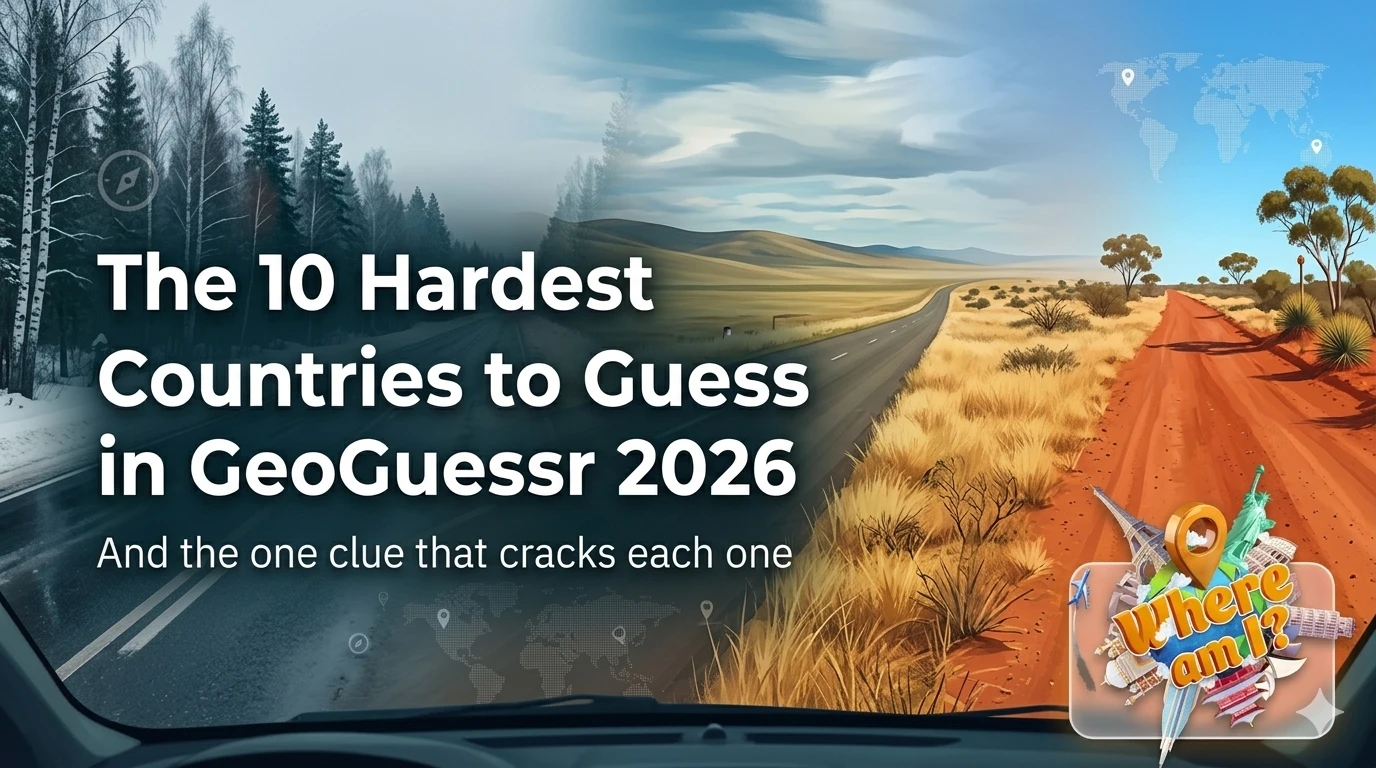
Every GeoGuessr player knows the feeling. You spawn on a flat, empty road with no signs, no people, and a horizon that could be three different continents. Some countries do this to you again and again. They look like their neighbors, hide their clues, or sprawl across so much land that one road tells you almost nothing.
This list ranks the ten countries that trip up even strong players, and more importantly, the one clue that cracks each one. Treat it as a field guide. Learn the tell for each country here, then go drill it on real rounds until the panic turns into a fast, confident guess.
Looking for hard country names rather than hard locations? If you’re picking a word for hangman or a party game, see the 50 hardest countries to guess by name, ranked by a letter-by-letter difficulty score.
Key Takeaways
- Big, sparse countries are the hardest: Russia alone covers 17.1 million square kilometers, more than any other nation (Worldometer, 2026).
- Most “impossible” drops are solvable through one tell: script, driving side, plate color, or the Google car.
- Lookalike clusters (the Baltics, southern Africa, the South American interior) cause more wrong guesses than truly remote places.
- You can practice all ten countries for free in Where Am I?, with no paywall and no daily limit.
What makes a country hard to guess in GeoGuessr?
A country is hard to guess when it offers few unique clues, looks like its neighbors, or covers so much ground that any single road feels generic. Google Street View spans more than 110 countries and over 10 million miles of road (Google / Wikipedia, 2025), so the challenge is rarely about a missing map. It’s about reading subtle signals.
Three traits make a country brutal. Size, because a vast nation contains endless similar terrain. Sparseness, because empty roads strip away signs and storefronts. And confusion, because some regions share scripts, plants, and architecture with their neighbors. The ten below combine at least two of these traits. The good news? Each still leaves one reliable fingerprint.
1. Russia: the endless birch and pine
Russia is the single toughest country because it’s the largest on Earth at 17.1 million square kilometers (Worldometer, 2026), and vast stretches of it look identical. A snowy road through birch and pine could be Siberia, but it could also pass for Canada or Scandinavia. That twin problem is what sinks most guesses.
 Endless birch and pine roads make Russia easy to confuse with Canada or Scandinavia. Image via Wikimedia Commons.
The tell: Cyrillic on any sign ends the debate instantly. No sign? Russian bollards are white with two thin black bands near the top, and rural signage often rides on an older, grainier camera. Pair those and you’re home.
2. Canada: the boreal twin
Canada is the second largest country on the planet at nearly 10 million square kilometers (Worldometer, 2026), and its boreal forest is a dead ringer for Russia. The Prairies, meanwhile, blend into the American Midwest. Players lose Canada by confidently clicking the wrong northern country.
 Canada’s boreal forest and open roads closely mirror Russia and Scandinavia. Image via Wikimedia Commons.
The tell: look for the Latin script that rules out Russia, then French on signs (Quebec) or bilingual text. Yellow center lines, frequent stop signs, and the occasional “.ca” web address seal it. The Google car here often shows a clean, modern rig.
3. Mongolia: the empty steppe
Mongolia fools players because its steppe is huge, almost roadless, and thinly mapped. Long stretches are dirt tracks with nothing but grass, sky, and the odd herd of livestock. With so few human clues, the country feels like a coin flip between several Central Asian neighbors.
 Wide, empty steppe with almost no signage is what makes Mongolia so hard. Image via Wikimedia Commons.
The tell: Mongolian uses a distinct Cyrillic alphabet, so any text narrows it fast. The Street View car is also unusually recognizable, and rolling treeless grassland with free roaming livestock points straight here.
4. Australia: the generic Outback
Australia covers 7.7 million square kilometers (Worldometer, 2026), and its red, scrubby Outback looks the same for hundreds of miles. Drop into the interior and you could swear you’re in parts of Africa or the American Southwest. The sheer sameness is the trap.
 The red, scrubby Outback looks the same for hundreds of miles. Image via Wikimedia Commons.
The tell: Australia drives on the left, which already removes most lookalikes, since only about 76 countries do (WorldStandards, 2026). Add rusty red soil, eucalyptus trees, and long road trains, and you’ve locked it in.
5. Botswana: the southern Africa puzzle
Botswana is hard because its flat, dry savanna blends seamlessly into Namibia, Zimbabwe, and South Africa. The region shares the same golden grass, thorny scrub, and big skies, so players often land in the right neighborhood but the wrong country.
 Botswana’s savanna looks much like its neighbors, so the driving side and the Google car matter most. Image via Wikimedia Commons.
The tell: Botswana drives on the left, which separates it from many regions. The Street View vehicle in southern Africa is often a giveaway, and roaming cattle near fenced highways lean toward Botswana specifically.
6. Indonesia: the island maze
Indonesia scatters across roughly 17,000 islands (Britannica, 2026), and its tropical roads resemble those of Malaysia, Thailand, and the Philippines. Palms, scooters, and humid haze are everywhere in the region, so the usual landscape cues fail you here.
 Lush tropical roads in Indonesia look much like those across Southeast Asia. Image via Wikimedia Commons.
The tell: Indonesia drives on the left, which rules out the Philippines. Indonesian language on shopfronts, red and white plate accents, and mosque architecture in much of the country point you to the right archipelago.
7. Brazil: the South American giant
Brazil is the fifth largest country at 8.5 million square kilometers (Worldometer, 2026), ranging from Amazon rainforest to dry sertão to temperate south. That variety means one Brazilian road rarely looks like the next, and players often guess a neighboring country instead.
 Brazil ranges from rainforest to dry plains, so one road rarely looks like the next. Image via Wikimedia Commons.
The tell: language is everything here. Portuguese, not Spanish, instantly separates Brazil from the rest of the continent. Mercosur plates with a blue top band and “.br” addresses confirm it.
8. Kazakhstan: the second steppe trap
Kazakhstan is the ninth largest country on Earth (Worldometer, 2026), and much of it is flat steppe that mirrors both Russia and Mongolia. Empty highways under enormous skies give almost nothing away, so this is a classic “somewhere in the middle of Asia” panic.
 Kazakhstan’s flat steppe mirrors both Russia and Mongolia. Image via Wikimedia Commons.
The tell: signs may mix Kazakh and Russian Cyrillic, and the plate format differs from Russia’s. Soviet era infrastructure, lonely power lines, and a particular dusty palette all nudge you toward Kazakhstan.
9. New Zealand: the Australia mixup
New Zealand catches players who reflexively click Australia, the UK, or Ireland. The rolling green hills genuinely resemble the British Isles, while the driving side matches Australia. Without a sharp eye, it’s an easy country to throw away.
 New Zealand’s rolling green hills can pass for the British Isles. Image via Wikimedia Commons.
The tell: look for tree ferns and dense temperate rainforest that Australia lacks, the yellow diamond road signs, and “.nz” web addresses. The dramatic mountains of the South Island are another strong hint.
10. Argentina: the featureless Pampas
Argentina rounds out the list because its vast Pampas grassland is flat, fenced, and almost featureless. Long stretches look like Uruguay or rural Chile, and the lack of landmarks leaves you leaning on small details most players overlook.
 The flat, fenced Pampas of Argentina offers few landmarks to guess from. Image via Wikimedia Commons.
The tell: Spanish confirms South America, then Mercosur plates and Argentine bollards narrow the country. Rows of poplar windbreaks beside arrow straight roads are a quiet but reliable Argentina signature.
How do you stop losing points on hard countries?
You stop losing points by checking clues in a fixed order instead of guessing on vibes. Every country above is beatable once you read the right signal: script, driving side, plate, or the Google car. The players who score well aren’t lucky, they simply run the same checklist on every drop.
Our take: the fastest improvement comes from studying lookalike clusters, not rare locations. Learn to split Russia from Canada, Botswana from Namibia, and New Zealand from Australia, and your average score climbs more than any amount of memorizing flags.
For the full clue by clue system behind these tells, read our guide on how to get better at GeoGuessr. If southern Africa keeps tripping you up, our Namibia street view guide breaks down that exact desert region.
Practice these hard countries for free
You can drill every country on this list for free in Where Am I?, with unlimited rounds and no subscription. That matters in 2026, because GeoGuessr ended its free unlimited mode in February 2024 and now charges up to $6.99 per month for unlimited play (Sportskeeda, 2026).
For the full breakdown of what the free plan still includes, see is GeoGuessr free in 2026.
Where Am I? drops you into immersive street walk videos instead of frozen images, so you can watch the landscape, bollards, and plates roll past in motion. It’s free on iOS, Android, and the web, with daily challenges, duels, and weekly tournaments to test your skills.
Ready to face the hardest drops? Play Where Am I? free and start training your eye. New to the genre? Browse the 10 best free GeoGuessr alternatives in 2026 to find your practice ground.
Frequently Asked Questions
Russia is widely considered the hardest, mainly because it’s the largest country on Earth at 17.1 million square kilometers (Worldometer, 2026). Endless birch and pine roads look identical to Canada and Scandinavia, so only the Cyrillic script reliably saves your guess.
Large countries contain huge spans of repeating terrain, so one road rarely reveals the region. With over 10 million miles of Street View road worldwide (Wikipedia, 2025), giants like Russia, Canada, and Australia offer countless near identical drops that punish guessing on landscape alone.
Yes, and it’s one of the strongest filters available. Only about 76 countries and territories drive on the left (WorldStandards, 2026), so spotting left side traffic instantly separates Australia, Botswana, Indonesia, and New Zealand from most of the world.
Free games let you train these drops at no cost. GeoGuessr now charges up to $6.99 per month for unlimited play (Sportskeeda, 2026), while free alternatives such as Where Am I? offer unlimited rounds covering the same tricky regions.
Final thoughts
The hardest countries in GeoGuessr aren’t unbeatable, they’re just quiet. They hide their clues behind sameness and lookalike neighbors, which is exactly why a fixed checklist beats raw memory. Spot the script, check the driving side, read the plate, and study the Google car, and even Russia or Mongolia becomes a confident click.
Pick three countries from this list, learn their tells, and put them to the test on real rounds. Play Where Am I? free and turn your worst drops into your best guesses.
Disclaimer: Where Am I? is an independent game and is not affiliated with GeoGuessr or Google.
Sources
- Worldometer, “Largest Countries in the World by Area,” retrieved June 19, 2026, https://www.worldometers.info/geography/largest-countries-in-the-world/
- Wikipedia, “Google Street View,” retrieved June 19, 2026, https://en.wikipedia.org/wiki/Google_Street_View
- WorldStandards, “List of left and right driving countries,” retrieved June 19, 2026, https://www.worldstandards.eu/cars/list-of-left-driving-countries/
- Britannica, “Indonesia,” retrieved June 19, 2026, https://www.britannica.com/place/Indonesia
- Sportskeeda, “GeoGuessr going paid after ending free subscription,” retrieved June 19, 2026, https://www.sportskeeda.com/esports/news-corpo-gonna-corpo-geoguessr-going-paid-ending-free-subscription-fans-disappointed

The Where Am I? team builds a free geography guessing game that drops players into street walk videos from around the world and challenges them to pin their location on the map as accurately as possible.
Available on iOS and Android, the game offers campaign challenges, tournaments, live multiplayer duels, global leaderboards, and a collection system built around famous monuments such as the Eiffel Tower, the Colosseum, and the Statue of Liberty.
Positioned as a free alternative to GeoGuessr with no paywall, Where Am I? makes geography gaming open to every kind of player.
On this blog the team shares guides, country breakdowns, and practical tips that help players read visual clues, climb the leaderboard, and explore the world from their screen.