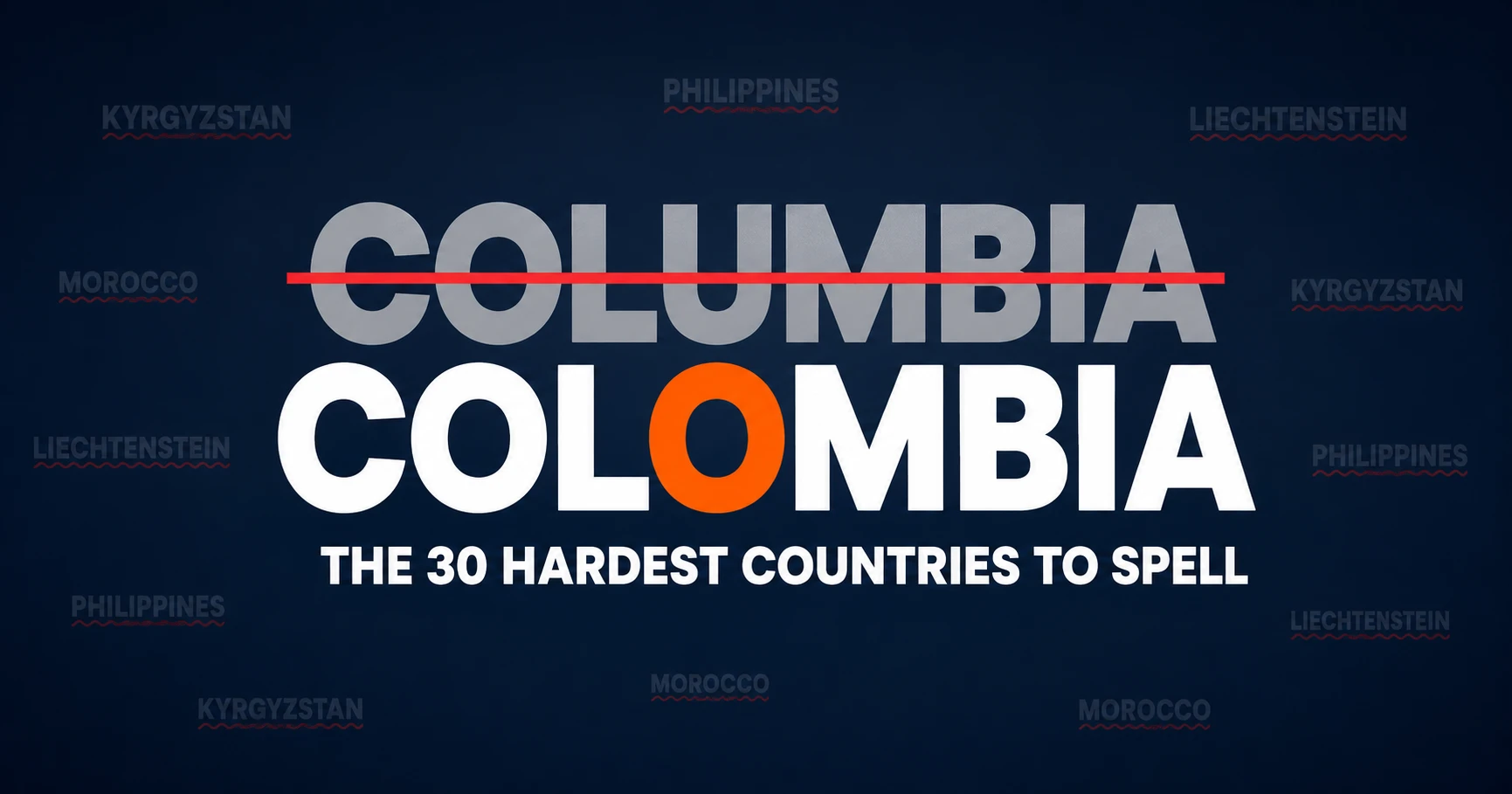
Colombia is the most misspelled country name in the world. It is also the 107th hardest country name to spell, out of 196. That gap is not a contradiction. It is the entire reason people keep getting it wrong.
Colombia has exactly one plausible way to go wrong, and that one wrong version is invisible. Kyrgyzstan is a minefield of six separate spelling traps, and every wrong version of it gets a red underline the moment you type it.
We scored all 196 country names on three letter-level factors and ranked them. The full 30 is below, along with the four doubling traps, the six names your spellchecker will never fix, and the pairs of countries that sit close enough to swap.
Key Takeaways
- Kyrgyzstan ranks #1 at 62.4 out of 100. Its ZST run appears in zero English dictionary words, and both of its Y’s are doing a vowel’s job.
- Colombia ranks 107th for difficulty and first for actual misspellings, because “Columbia” is a real place and no spellchecker objects.
- Only 9 of 196 country names contain a doubled consonant inside one word. Four of those double one letter while leaving a neighbour single, which is the trap that catches Morocco and the Philippines.
- 57 country names have a plausible misspelling that is a real English word. Six of them land on another country or a famous place.
- Prefer finding countries to spelling them? Play Where Am I? free, with no login and no daily limit.
Why Colombia is the most misspelled country in the world
Colombians have been fighting this one for over a decade. By April 2014 the campaign, which runs under the hashtag #ItsColombiaNotColumbia, had enough momentum that the Washington Post covered it. Campaigners screenshot the offenders and correct them in public. The list of people who have got it wrong includes Justin Bieber, Ozzy Osbourne, Starbucks, the NBA, ESPN, NBC, CBS, the BBC and The Economist (The World, 2016).
Here is why it keeps happening, and it is not carelessness.
Both spellings descend from the same man. Christopher Columbus was Cristoforo Colombo in Italian and Cristóbal Colón in Spanish. English took the Latin route and produced Columbia, which was already in use as a poetic name for the American colonies in the 1730s. Spanish took the Italian route and produced Colombia, which the South American republic adopted as its permanent name in 1863 (Online Etymology Dictionary).
So the U spelling had roughly 130 years of head start in English before the O spelling existed as a country. An English speaker reaching for that vowel is being pulled by the District of Columbia, Columbia University, British Columbia and Columbia Records, all of which are correct, and all of which are spelled the other way.
Now the mechanical part. Type “Kyrgistan” and your software underlines it in red. Type “Columbia” and nothing happens, because Columbia is a place. A misspelling only survives if the spellchecker stays quiet, and Colombia’s single error is the quietest one in the whole set of country names.
That is why being hard to spell and being often misspelled are close to opposites here. The names that are genuinely difficult get corrected automatically. The names that are easy get published wrong.
How we scored all 196 country names
The score is mechanical and you can reproduce it. We took the 193 UN member states (United Nations) plus Kosovo, Palestine and Vatican City, using the short English names mainstream quiz platforms use.
Each name gets a Spelling Difficulty Score from 0 to 100, built from three components:
| Component | Weight | What it measures |
|---|---|---|
| Grapheme ambiguity | 40 pts | Sounds that have more than one spelling in English |
| Doubling ambiguity | 35 pts | Single-or-double consonant decisions the sound cannot settle |
| Cluster load | 25 pts | Consonant runs that are rare in English, plus word length |
Three assumptions worth stating up front.
We score only the distinctive words. “United Kingdom” and “Central African Republic” score zero, because every word in them is ordinary English. Stringing easy words together does not make a name hard to spell.
A consonant run counts as hard only if it is rare in English. We test that against /usr/share/dict/words, the Webster’s Second International list that ships with macOS, at 234,456 distinct entries. Australia’s STR and Kingdom’s NGD are three letters long and completely native, so an English speller writes them without thinking. Kyrgyzstan’s ZST and Liechtenstein’s CHT are not.
Autocorrect blindness is reported separately and never folded into the score. Mixing “hard to write” and “often written wrong” into one number produces a ranking nobody can defend, and it is the mistake that makes every other list on this topic unusable.
The 30 hardest country names to spell, ranked
Score runs 0 to 100. “Letters” counts letters only, ignoring spaces and hyphens.
| # | Country | Score | Letters | The trap |
|---|---|---|---|---|
| 1 | Kyrgyzstan | 62.4 | 10 | ZST appears in almost no English word, and both Y’s are vowels |
| 2 | Philippines | 55.5 | 11 | One L, two P’s, and a PH that sounds like F |
| 3 | Guinea-Bissau | 52.3 | 12 | Double S in Bissau, single N in Guinea |
| 4 | Sierra Leone | 48.3 | 11 | Double R in Sierra, single N in Leone |
| 5 | Morocco | 41.0 | 7 | One R, two C’s, and nothing to tell you which |
| 6 | Kazakhstan | 40.9 | 10 | KH, plus a Z where an S would sound identical |
| 7 | Liechtenstein | 40.4 | 13 | IE then EI, around a CHT that reads as silent |
| 8 | Equatorial Guinea | 36.8 | 16 | UA and UI vowel pairs in the same name |
| 9 | Afghanistan | 34.9 | 11 | GH with an H you cannot hear |
| 10 | Paraguay | 31.7 | 8 | UA in the middle, UAY at the end |
| 11 | Uruguay | 31.0 | 7 | Two U’s and the same UAY ending |
| 12 | Djibouti | 30.3 | 8 | DJ opening, and an OU that sounds like OO |
| 13 | Bosnia and Herzegovina | 28.2 | 20 | A Z that could be an S, in a name few people ever write |
| 14 | Saint Vincent and the Grenadines | 27.5 | 28 | Soft C, and length that invites a slip |
| 15 | Papua New Guinea | 26.4 | 14 | UA, UI and EA in one name |
| 16 | Trinidad and Tobago | 26.1 | 17 | Four doubling decisions, none of them doubled |
| 17 | Mauritania | 24.9 | 10 | AU, and a near twin in Mauritius |
| 18 | Marshall Islands | 24.8 | 15 | The LL that people give to Marshal |
| 19 | Switzerland | 24.5 | 11 | TZ, a cluster English almost never spells that way |
| 20 | Guatemala | 24.2 | 9 | UA opening, three single consonants after it |
| 21 | Nicaragua | 24.2 | 9 | UA at the end instead of the start |
| 22 | North Macedonia | 24.2 | 14 | Soft C that sounds like S |
| 23 | Venezuela | 24.2 | 9 | Z that could be S, twice over |
| 24 | Luxembourg | 23.7 | 10 | One of only two country names with an X, plus a French OU |
| 25 | Azerbaijan | 23.6 | 10 | Z and J in the same name |
| 26 | Micronesia | 23.6 | 10 | The S sounds like a Z |
| 27 | Mozambique | 23.6 | 10 | Z and QUE, the only name with both |
| 28 | Seychelles | 23.5 | 10 | LL, plus a CH that sounds like SH |
| 29 | Indonesia | 23.0 | 9 | Another S doing a Z’s work |
| 30 | Saint Kitts and Nevis | 23.0 | 18 | TT buried in a three-consonant run |
Why Kyrgyzstan wins
Kyrgyzstan is the only name in the ranking that is hard in all three ways at once.
Its ZST run is the rarest consonant cluster in any country name. Of the 234,456 entries in the Webster’s Second word list, exactly zero contain it, so no English speller has muscle memory for that letter order.
Both of its Y’s are doing a vowel’s job, and neither is in a position where English normally puts one. GY, YR and YZ are all sequences that give you no sound-based clue about what to write.
And the whole name arrived in English through transliteration from Cyrillic, which means there was never one authoritative English spelling to learn in the first place.
The result is a name where almost every letter is a decision. It is also, for exactly that reason, a name that rarely appears misspelled in published writing. Every wrong version is so clearly wrong that software catches it.
The four doubling traps
Only 9 of the 196 country names contain a doubled consonant inside a single word: Andorra, Guinea-Bissau, Marshall Islands, Morocco, Philippines, Russia, Saint Kitts and Nevis, Seychelles and Sierra Leone.
Four of those are worse than the rest, and they are worse in the same specific way. Each one doubles one consonant while leaving a comparable neighbour single. The name proves that something doubles. It just refuses to tell you what.
The Philippines is the clearest case, and its history explains it. The islands were named in 1543 for the Spanish crown prince who became Philip II. Spanish produced Islas Filipinas, from Latin Philippinae, and English borrowed it as the Philippines (Wikipedia). The doubled P comes from the Latin form. The English personal name Philip has one L and one P, so anyone reasoning from the name rather than the Latin lands on “Phillipines” and gets it exactly backwards.
Morocco is the purest trap in the set because it is short. Seven letters, one R, two C’s, and no rule available to tell them apart.
The six names your spellchecker will never fix
We generated plausible misspellings for every country name using four error types that people actually produce: vowel substitution, vowel deletion, consonant doubling toggled on or off, and adjacent letter swaps. Then we checked whether each result was a real word.
57 of the 196 country names have at least one plausible misspelling that is a real English word. Six of them land on another country or a place famous enough that you would never doubt what you typed.
| Country | Becomes | Why it survives |
|---|---|---|
| Colombia | Columbia | A US district, a university, a Canadian province and a record label |
| Chile | Chili | A food you write more often than the country |
| Hungary | Hungry | Drop one letter and you get an everyday adjective |
| Guyana | Guiana | French Guiana is next door and spelled the other way |
| Cameroon | Cameron | A common surname and given name |
| Angola | Angela | A given name one vowel away |
These six are the names that reach print wrong. Everything in the top 10 of the difficulty ranking gets caught before publication, which is precisely why you rarely see “Kyrgistan” in a newspaper and regularly see “Columbia”.
Country names that collide with each other
A different kind of error: the name you typed is a different country. Twenty-six pairs sit within two edits of each other. These are the ones worth knowing.
| Pair | Edits apart | Why it bites |
|---|---|---|
| Iran / Iraq | 1 | One letter, two very different countries |
| Gambia / Zambia | 1 | Only the first letter differs |
| Iceland / Ireland | 1 | The C and the R sit in the same slot |
| Austria / Australia | 2 | Two letters and roughly 16,000 kilometres apart |
| Niger / Nigeria | 2 | Niger is contained entirely inside Nigeria |
| Slovakia / Slovenia | 2 | Two real countries, two letters apart |
| Chile / China | 2 | Swap one letter and change hemisphere |
| Mali / Malta | 2 | One inserted letter changes continent |
Two country names sit entirely inside another: Niger inside Nigeria, and Guinea inside Guinea-Bissau. Dominica sits inside the Dominican Republic. In each case a correct spelling of the shorter name is still the wrong answer if you meant the longer one.
Where this score falls short
Three honest limitations.
It does not measure how often anyone actually gets it wrong. We measure the properties of the letters. Real misspelling frequency would need search or corpus data at a scale no public dataset currently covers for country names, which is exactly why the Colombia finding rests on documented reporting rather than on our score.
The grapheme table is a judgement call. We list which sound-to-letter mappings count as ambiguous, and a different linguist would draw that list slightly differently. The table is published in full in the score itself so you can disagree with specific entries.
It assumes an English speller. Cluster load is measured against an English dictionary, so a Polish or Turkish speaker would find a very different set of names hard. Kyrgyzstan is far less alarming if your own language uses those letter runs.
Frequently asked questions
Kyrgyzstan, at 62.4 out of 100 on our score. Its ZST cluster appears in almost no English word, both of its Y’s function as vowels, and the whole name reached English through transliteration from Cyrillic, so there was never a single obvious spelling to learn.
Colombia. It is frequently written “Columbia” because both spellings descend from Christopher Columbus, and the U version has been in English since the 1730s. Colombians have run a public campaign, #ItsColombiaNotColumbia, since 2014.
No. Colombia ranks 107th of 196 for difficulty. It is the most misspelled because its one likely error produces “Columbia”, a real place that no spellchecker flags. Hard to spell and often misspelled are close to opposite properties.
Because it has one L and two P’s, and the English name Philip has the reverse. The doubled P comes from the Latin Philippinae by way of Spanish Filipinas. Reasoning from “Philip” produces “Phillipines” every time.
Nine contain a doubled consonant within a single word: Andorra, Guinea-Bissau, Marshall Islands, Morocco, Philippines, Russia, Saint Kitts and Nevis, Seychelles and Sierra Leone.
Morocco, at seven letters. One R, two C’s, and nothing in the pronunciation to tell you which consonant doubles.
Any name built entirely from ordinary English words scores zero: the United Kingdom, the United States, the United Arab Emirates, South Africa and the Central African Republic. Among single-word names, Laos, Chad and Malta are the easiest.
From spelling countries to finding them
Spelling a country is one kind of puzzle. Finding one is another, and it is harder in a completely different way: no letters to work with, just architecture, road markings, vegetation and the occasional sign.
If you want that version, Where Am I? drops you into a real street somewhere on Earth and asks you to place it on the map. It is free, it runs in your browser, there is no login and there is no daily limit.


Once you are playing, these are the natural next reads:
- The 50 Hardest Country Names to Guess, Ranked and Scored: the same 196 names scored on a completely different question, letter by letter
- The 10 Hardest Countries to Guess in GeoGuessr: the Street View version, and a completely different top 10
- How to Get Better at GeoGuessr: 2026 Meta Guide: the clues that identify a country in seconds
- Capitals of the World: The Ultimate Quiz Game: if names are your thing, capitals are the harder tier
Disclaimer: Where Am I? is an independent game and is not affiliated with GeoGuessr or Google. Rankings reflect our own letter-level scoring method, described above, and are not an official difficulty standard.
Sources
- United Nations, “Member States,” retrieved 2026-08-13, https://www.un.org/en/about-us/member-states
- The World (PRX), “Colombians want the world to stop misspelling their country’s name,” retrieved 2026-08-13, https://theworld.org/stories/2016/07/30/colombians-want-world-stop-misspelling-their-countrys-name-its-colombia-not-columbia
- Online Etymology Dictionary, “Colombia” and “Columbia,” retrieved 2026-08-13, https://www.etymonline.com/word/Colombia
- Washington Post, “Colombians just want you to stop misspelling their country’s name,” 2014-04-23, https://www.washingtonpost.com/news/morning-mix/wp/2014/04/23/colombians-just-want-you-to-stop-misspelling-their-countrys-name/
- Wikipedia, “Names of the Philippines,” retrieved 2026-08-13, https://en.wikipedia.org/wiki/Names_of_the_Philippines
- Best Life, “These Are the Most Misspelled Countries in the World,” retrieved 2026-08-13, https://bestlifeonline.com/most-misspelled-countries/
- Webster’s Second International word list, as distributed at /usr/share/dict/words, 234,456 distinct entries, used for the English-word and consonant-cluster tests
- Where Am I?, original analysis: Spelling Difficulty Score computed across 196 country names, method described in the “How we scored” section above

The Where Am I? team builds a free geography guessing game that drops players into street walk videos from around the world and challenges them to pin their location on the map as accurately as possible.
Available on iOS and Android, the game offers campaign challenges, tournaments, live multiplayer duels, global leaderboards, and a collection system built around famous monuments such as the Eiffel Tower, the Colosseum, and the Statue of Liberty.
Positioned as a free alternative to GeoGuessr with no paywall, Where Am I? makes geography gaming open to every kind of player.
On this blog the team shares guides, country breakdowns, and practical tips that help players read visual clues, climb the leaderboard, and explore the world from their screen.